
TEC Modules
A TEC module — also called a Peltier module or thermoelectric cooler — is a solid-state heat pump. Run DC current through it and one ceramic face goes cold while the other goes hot; reverse the current and they swap. Use one when something has to sit below room temperature, or hold one exact temperature while the room moves around it — a laser diode, an image sensor, a PCR block. If you only need to carry heat away to ambient, a heat sink and a fan will do it for less money and less power.
ATI stocks 202 single-stage modules in five families, 0.3 W to 378 W of cooling, from $10.30. Footprints run from 2.5 × 2.5 mm, small enough for a laser submount, up to 62 × 62 mm. Most parts come in sealed and non-sealed versions at the same price, with high-temperature versions for surfaces up to 200 °C and long-life versions for instruments that cycle.
Find your TEC module
Filter by module type, cooling power, footprint or maximum current. Every row shows Qmax, Imax, Vmax, ΔTmax, dimensions, price, stock and a link to the datasheet. Not sure where to start? Match the footprint to your cold plate first — that takes 202 parts down to a handful. The family guide below tells you which of the five types you need, and a 20 × 20 mm regular rectangular module is the right answer for a lot of benchtop and instrument work.
Showing 73–84 of 202 resultsSorted by price: low to high
| Image | SKU | Type | Qmax (W) | Imax (A) | Vmax (V) | ΔTmax (°C) | Lc (mm) | W (mm) | H (mm) | Datasheet | Price | Stock | Action |
|---|---|---|---|---|---|---|---|---|---|---|---|---|---|
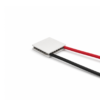 |
ATE1-31-4A | Regular Rectangular | 10.4 | 4 | 3.7 | 62 | 15 | 15 | 3.14 | $22.69 | 3 | ||
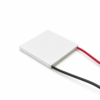 |
ATE1-127-15AS | Regular Rectangular | 126 | 15 | 15.4 | 66 | 40 | 40 | 3.5 | $24.41 | 39 | ||
|
ATE1-127-10AS | Regular Rectangular | 85 | 10 | 15.4 | 66 | 40 | 40 | 3.4 | $24.50 | 14 | ||
|
ATE1-127-9AS | Regular Rectangular | 80 | 9.5 | 15.4 | 65 | 40 | 40 | 3.2 | $24.50 | 18 | ||
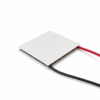 |
ATE1-127-12A | Regular Rectangular | 95 | 12 | 15.4 | 65 | 40 | 40 | 3.2 | $24.69 | Made to Order | ||
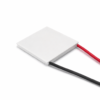 |
ATE1-127-3BS | Regular Rectangular | 20 | 3 | 15.4 | 65 | 30 | 30 | 3.8 | $24.69 | 13 | ||
|
ATE1-127-12AS | Regular Rectangular | 95 | 12 | 15.4 | 65 | 40 | 40 | 3.2 | $24.69 | 41 | ||
|
ATE1-127-3B | Regular Rectangular | 20 | 3 | 15.4 | 65 | 40 | 40 | 3.8 | $24.69 | 13 | ||
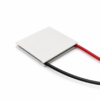 |
ATE1-TCHE-127-3A | TC High-Efficiency | 28 | 3 | 18.1 | 83 | 29.7 | 29.7 | 3.8 | $25.00 | Made to Order | ||
|
ATE1-TCHE-71-6A | TC High-Efficiency | 32 | 6 | 10.1 | 83 | 29.8 | 29.8 | 4 | $25.00 | Made to Order | ||
|
ATE1-199-2AS | Regular Rectangular | 33.6 | 2 | 24 | 67 | 40 | 40 | 4.3 | $25.00 | 10 | ||
|
ATE1-199-3AS | Regular Rectangular | 50.4 | 3 | 24 | 67 | 40 | 40 | 4.3 | $25.00 | 9 |
Our Delivery Promise
Fast, flexible fulfillment from San Jose, California, USA — shipped worldwide.
- Fast in-stock shipping — In-stock orders ship within 1–2 business days after confirmation and quality check.
- Made-to-order models — Some models are produced to order. Contact sales@analogti.com for the current lead time.
- Worldwide shipping — Shipped from San Jose to customers worldwide.
- Flexible carrier options — UPS, FedEx, DHL, USPS, freight forwarders, or your preferred logistics partners.
- Clear shipment visibility — Tracking provided after dispatch to support your receiving and production planning.
Which family do I need?
Five families, and the choice is usually made by your environment rather than by cooling power. Pick the family first, then use the filter above for size and current.
| Family | Cooling power | Footprint | Max ΔT | Max surface temp | Choose this if… |
|---|---|---|---|---|---|
| Regular Rectangular ATE1-XX · 126 models · from $10.30 | 0.3 – 378 W | 2.5 × 2.5 to 62 × 62 mm | up to 80 °C | 125 °C | This is the one most people need. Widest range of sizes and power, lowest prices. |
| High-Temp Rectangular −H suffix · 41 models · from $12.00 | 2.8 – 218.4 W | 10 × 20 to 50 × 50 mm | up to 68 °C | 200 °C | Your hot side or your ambient goes past 125 °C. You trade a little ΔT for the extra headroom. |
| Thermal Cycling ATE1-TC · 22 models · from $27.11 | 8.1 – 194 W | 15 × 15 to 55 × 55 mm | up to 79 °C | 125 °C, or 200 °C on −H versions | Your current reverses at full scale over and over — PCR, thermal test, anything that heats then cools on a cycle. |
| TC High-Efficiency ATE1-TCHE · 11 models · from $25.00 | 21 – 80 W | 25 × 25 to 40 × 40 mm | 83 °C | 125 °C | Same cycling life, but you also care about the power bill or the battery. Highest ΔT we make. Non-sealed only. |
| Circular ATEC1-XX · 2 models · from $29.00 | 11.3 – 12.6 W | Ø24 and Ø26 mm, centre hole | up to 74.5 °C | 125 °C | You are cooling a TO-can laser or a round detector, and something has to pass through the middle. |
Reading a part number
- ATE1-127-6ASH breaks down as: 127 Peltier couples inside — more couples means more cooling and a bigger module. 6 is Imax in amps. Some part numbers put an R where the decimal point goes — R8 is 0.8 A, 7R8 is 7.8 A — and others write the decimal point out, as in ATE1-17-1.4A. The thermal-cycling families always use the R form. If a part number does not come up in search, try the other spelling. A or B is the footprint option for that couple count. S means sealed. H means high-temperature solder.
- Couple counts run 7, 8, 11, 17, 18, 19, 31, 32, 35, 38, 49, 63, 65, 71, 127, 161, 199, 241 and 288. If you have used another supplier's module, matching the couple count and the footprint usually gets you a drop-in replacement.
- Circular parts use two of the table columns differently. Lc is the outside diameter and W is the centre hole, so ATEC1-38-3.4A is Ø24 mm with a Ø10 mm hole through the middle, not a 24 × 10 mm rectangle.
- The −H suffix appears on both rectangular and thermal-cycling parts, so a high-temperature cycling module such as ATE1-TC-127-6ASH is filed under Thermal Cycling, not High-Temp Rectangular.
- ΔTmax and Qmax are laboratory ceilings, measured in vacuum with the hot side clamped at a fixed temperature. Your assembly will do less. Treat them as a way to rank parts, not as a promise.
- Price does not follow cooling power here. The smallest high-ΔT micro modules cost more than a 200 W part, because they are specialty items built in small volumes. Do not read a low price as a lesser part.
Cannot find the footprint or the couple count you need? Tell us the dimensions and the heat load and we will tell you whether we have it, or whether it is a custom build.
Three things to settle before you order
Most TEC problems in the field trace back to one of these three, not to the module itself.
1. Qmax is a ceiling, not a working point
Qmax is the heat a module can pump when both sides are at the same temperature and it is running at Imax. That is also its least efficient operating point. Real systems have a temperature drop and want efficiency, so the usual starting point is a module whose Qmax is roughly twice your actual heat load, then running it well below Imax. Efficiency climbs sharply as the temperature difference across the module falls, so a bigger heat sink often beats a bigger TEC.
2. Sealed or non-sealed
Sealed modules have the perimeter sealed against moisture. You want that whenever the cold side can drop below the dew point, which is most cooling applications, and in anything humid, portable or outdoors. Non-sealed is fine in dry, sealed enclosures or when you are only heating. In almost every series here the sealed and non-sealed versions are the same price, so when in doubt take the sealed one.
3. How you will mount it
Modules 30 mm and larger are usually clamped with thermal grease or a thermal pad, which is cheap and tolerant. Small modules of 20 mm and under are usually bonded with adhesive. Soldering gives the best thermal path for small long-life assemblies. Whatever you choose, keep the pressure even and keep sideways force off the module — TECs take compression well and crack under shear. We review mounting designs at no charge.
Why buy TEC modules from ATI
- One supplier for the whole range — 20+ series from 7 to 288 couples, 0.3 W to 378 W, in one catalogue with one set of part-number rules. You are not stitching a thermal design together from four vendors.
- RoHS and REACH compliant — Every module is 100 % lead-free, and the certificates are on file: RoHS certificate and REACH certificate of compliance.
- Long-life modules for cycling work — Standard TECs fatigue after roughly a thousand full-scale current reversals. Our ATE1-TC and ATE1-TCHE series are built to take up to 20,000. If your instrument cycles, this is the difference between a service call and no service call.
- We screen for the failure that actually happens — TECs die by internal cracking, which shows up as rising AC resistance long before the module stops working. We pre-screen by initial ACR and offer burn-in on request, and we sell the LCR meter you need to measure it yourself. A normal multimeter cannot see this.
- Published prices, no quote request — Every price on this page is the price. Purchasing can build a cost sheet without waiting on us.
- We make the controllers too — Our TEC controllers and NTC thermistors are designed alongside these modules, so pairing them is not guesswork. Ask us and we will name the matching controller.
Where these modules are used
Laser diodes and optics
Holding a diode at one temperature keeps its wavelength and output power steady. Small modules bond directly to a submount; circular modules fit TO-can packages without blocking the beam.
Imaging sensors and detectors
Cooling a CCD, CMOS or infrared sensor below ambient cuts dark current and noise. Sealed modules matter here, because the cold face runs below the dew point.
PCR and life-science instruments
Thermal cyclers reverse the current thousands of times over an instrument's life. The ATE1-TC and ATE1-TCHE families exist for exactly this duty.
Enclosure and electronics cooling
Solid-state cooling with no compressor, no refrigerant and no moving parts, for cabinets, analysers and sealed boxes where a fan alone cannot get below ambient.
High-ambient industrial
Where the mounting surface itself runs hot — process equipment, engine bays, downhole tools — the −H parts survive surface temperatures up to 200 °C.
Test and calibration fixtures
Driving a device under test to a set temperature and holding it there, in benchtop rigs where a chamber would be too slow or too large.
Frequently asked questions
Which side is the cold side, and which lead is positive?
Mount the face the lead wires are soldered to against your heat sink. That face becomes the hot side, and the opposite face is the cold side where your load goes. The positive lead is defined so that connecting it to the positive of a DC supply cools that pre-defined cold face. Reverse the leads and the module heats instead — that is normal operation, not damage.
Will I really get the Qmax and ΔTmax on the datasheet?
No, and no supplier's module will. Both numbers come from a vacuum test with the hot side held at a fixed temperature. In a real assembly, heat-sink resistance, mounting quality and ambient temperature all take a share. Use the datasheet figures to compare parts against each other, then size with margin: a module rated around twice your real heat load, run below its maximum current.
How long does a TEC module last, and what ends its life?
They wear out from inside. Each temperature swing expands and contracts the semiconductor elements, and eventually micro-cracks form. The accepted end-of-life marker is a 10 % rise in the module's AC resistance. What drives that is how often you reverse the current at full scale, not how many hours it has been powered. A module holding a steady setpoint can run for years; one cycling hard every few minutes needs the long-life series.
Do I need a sealed module?
If the cold side will sit below the dew point of the surrounding air, yes — condensation on an unsealed module will find its way inside. That covers most cooling applications, and anything humid, portable or outdoors. Non-sealed is acceptable in a dry sealed enclosure, or if you are only heating. Since sealed and non-sealed carry the same price in almost every series here, the sealed version is the safer default.
Can I check a TEC module with a multimeter?
Not usefully. A multimeter reads DC resistance, which barely moves as the internal elements crack. Cracking shows up in AC resistance, so it takes an LCR meter. This matters if you are buying modules for a long-life product: measuring ACR on arrival gives you a baseline, and measuring it again later tells you how much life is left. We stock a suitable meter and can pre-screen modules by initial ACR before shipping.
What is the difference between a TEC module and a TEG module?
They run the same physics in opposite directions. A TEC takes current in and produces a hot side and a cold side — the Peltier effect. A TEG takes a temperature difference and produces a voltage you can draw power from — the Seebeck effect. The construction looks similar, but each is optimised for its own direction, so a TEC used as a generator performs poorly and vice versa. Everything on this page is a TEC.
Can I drive a TEC module straight from a DC supply?
You can, and for simple heating or a fixed cooling load it works. What you lose is regulation: the load temperature drifts with ambient and with the heat your device generates. Holding a setpoint takes a closed loop — a temperature sensor, and a controller that adjusts both the size and the direction of the current. See our TEC controllers for modules that do this, and our NTC thermistors for the sensor.
Can I drive a TEC module with PWM?
Yes, but keep the switching frequency at 1 kHz or above; higher is gentler on the module. Slow or hard on/off switching puts the internal elements through sharp temperature swings, which is precisely what shortens their life. Smooth, slowly varying DC is ideal. Our controllers are designed with this in mind.
How should I attach the module to my heat sink and my load?
Three usual methods. Clamping with thermal grease or a thermal pad suits modules 30 mm and larger, is the cheapest, and tolerates the most abuse. Adhesive bonding suits small modules of 20 mm and under, such as laser diode coolers. Soldering gives the lowest thermal resistance for small assemblies where mechanical shock is controlled. In every case keep the clamping pressure even and avoid twisting or sideways loads. Send us your mechanical layout and we will review it at no charge.