
SMD Components & Kits
Everything in this section solves one problem: having the right value on the bench at the moment you need it. An SMD component kit is every value you are likely to reach for, sorted into its own lidded, labelled bin — for the stage of a project where the value still changes three times in an afternoon. A decade box is for the step before that, when you are finding the value and do not want to solder anything yet. If you already know what your design needs and you are building in volume, buy reels; kits are for everything that happens before then.
ATI has been building these since 1997. Six categories, 44 products, from $79: resistor kits in 0201 to 1206 with tolerances down to 0.1 %, MLCC kits spanning 0.5 pF to 220 µF, inductor kits in three packages, switch-selected resistance and capacitance decade boxes, empty enclosures and blank labels for stock you already own, and bench measurement tools. Every kit arrives in a case where each value has its own lidded bin — 128 or 200 of them — rather than a book of taped strips. Prices are published on every page, and everything ships from San Jose, California.
The six categories
Three of these are component kits, split by what is in the bins — resistors, capacitors, inductors. Inside each one the decisions are the same and come in the same order: the package your boards use, then the tolerance or the range your circuits need, then how deep you want each bin stocked. The other three support that work: R/C decade boxes for finding a value before you commit to it, empty boxes and labels for extending a kit or getting loose stock into bins, and tools and accessories for measuring what you fitted. Outfitting a bench from nothing, most people start with one resistor kit and one capacitor kit in the package they use most.
-
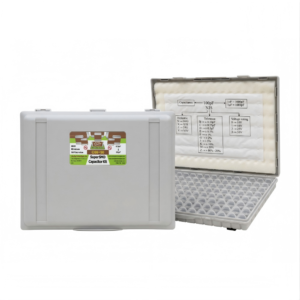
Capacitor Kits (12)
-
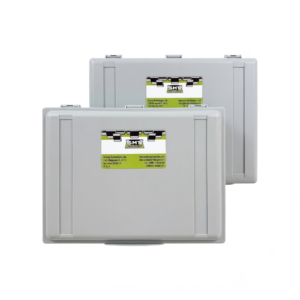
Empty Boxes (5)
-
Inductor Kits (4)
-
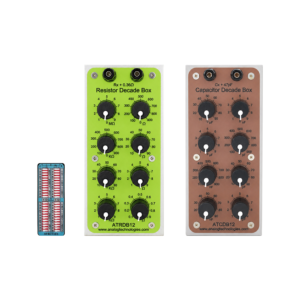
R/C Decade Boxes (3)
-
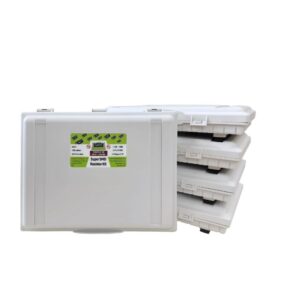
Resistor Kits (18)
-
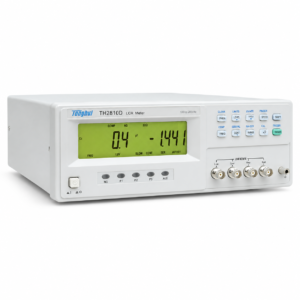
Tools & Accessories (2)
Which category do I need?
What you are doing decides this, not what you are buying. Each row goes to a category page where package size, tolerance and quantity are filters.
| Category | What is in it | Spread | Price | Go here if… |
|---|---|---|---|---|
| Resistor Kits 18 kits, 58 options | 61 – 760 values, 0201 to 1206 | 0 Ω – 100 MΩ, 5 % to 0.1 % | from $79 | The usual first buy. You are designing, debugging or repairing and you want the value your calculation asked for rather than the nearest one in the drawer. |
| Capacitor Kits 12 kits, 48 options | 35 – 96 values, 0402 to 1206 | 0.5 pF – 220 µF | from $99 | Decoupling, filtering, timing or rail work. A separate RF series covers the small values at tight absolute tolerances, where 2.2 pF and 2.4 pF are different answers. |
| Inductor Kits 0402, 0805, 1008 | 60 – 85 values, 20/50/100 pieces | signal and power packages | from $98 | Switching converters, LC filters and matching networks — the parts where the calculated value and the value that works are usually one step apart. |
| R/C Decade Boxes 3 instruments | resistance, capacitance, or both | 0.1 Ω – 100 MΩ / 1 pF – 100 µF | from $79 | You are still finding the value. Dial it in, watch the circuit respond, converge in minutes without touching a soldering iron — then fit a real part from a kit. |
| Empty Boxes & Labels 5 items | 128-bin and 200-bin cases, blank label sheets | — | — | You already have stock and want it in bins with lids, you are extending a kit with reels you bought, or you are splitting one kit across two benches. |
| Tools & Accessories 2 items | bench measurement | — | — | You want to confirm what you actually fitted — useful with inductors and small capacitors, which mostly carry no marking at all. |
What the three kit lines have in common
- The case is the same across all of them. Resistor, capacitor and inductor kits ship in the same enclosure family — 128 or 200 compartments, each with its own lid, and the value carried on the lid rather than on a position number you have to count to. Kits holding more values than fit in one case ship as a set bought under a single part number: the 170-value resistor kits are two cases, the 760-value kit is four.
- Part numbers read the same way in every line. A letter for the component, digits for the package, then the value series or value count, then the pieces supplied of each value. R06E96-200 is 0603 resistors, E96 series, 200 pieces each; C06-200 is 0603 capacitors at 200 pieces each; L0805-85VALUE-100PC is the 0805 inductor kit with 85 values at 100 pieces each.
- Values and quantity are separate decisions. More values means you land on the number you calculated; more pieces per value means you are not re-ordering in six months. They pull in opposite directions on price. If you are unsure, go wide on values first — running out of one value is an annoyance, not having it at all stops the job.
- Prices are published, and custom builds are worth asking about. We build these kits ourselves rather than reselling someone else's, so a different value list, package or quantity split is a conversation rather than a refusal. Tell us what you need and we will let you know whether we can put it together.
Outfitting a bench: three things to settle first
Kits sit on a bench for years, so the decisions you make once are worth a few minutes each.
1. Start with the value that changes most
On almost every bench that is resistors, then capacitors, then inductors. Resistors set gains, dividers, pull-ups and limits, and they get swapped more than anything else during bring-up. Capacitors come next because decoupling, filtering and timing all get tuned. Inductors change least often but are the hardest to substitute, since an unmarked part on the bench tells you nothing about itself. If the budget only stretches to one kit, buy the resistor kit.
2. Pick one package size and stay with it
Buy the package your boards actually use, and where the work is mixed, keep the whole bench on one size so parts from different kits are interchangeable in a hand-built prototype. 0603 is the usual compromise — small enough for dense layouts, still placeable with tweezers. 0805 and 1206 are easier to hand-solder and shed more heat, which suits repair and teaching. 0402 and 0201 are for dense commercial layouts and want a microscope.
3. Decide whether you need to find values or fit them
A decade box and a kit are not alternatives, they are two halves of the same job. The box sweeps fifty values in five minutes without a soldering iron, which is how you find the number. The kit is how you fit it, and it is the only one of the two that can stay in the circuit. Benches that do a lot of exploratory analog or filter work end up with both; benches that mostly build to a known design only need the kits.
Why buy kits from ATI
- The enclosure, which is the whole point of a kit — Our own patented design, and the reason these kits are still usable years after they are opened. The case holds 128 or 200 compartments; every compartment has its own lid with a handle and a legend area carrying the value, and each lid latches shut on its own. Opening one value leaves every other value closed and undisturbed, so finding a part is reading a lid rather than counting positions. The outer cover carries a resilient foam pad that presses all the small lids down when it closes, so a kit survives being carried to a customer site or shipped across the world without the bins emptying into each other.
- Packed the way kits actually get used — The Upgraded and Differential resistor kits supply larger quantities of the values you use constantly and smaller quantities of the ones you touch twice a year. In a kit where every bin holds the same count, the 10 kΩ bin empties first and the kit stops being useful while most of the other bins are still nearly full.
- Ranges other kit vendors skip — 0201 parts, 0.1 % tolerance, resistance out to 100 MΩ, 760-value sets, bulk ceramics to 220 µF, and a dedicated RF capacitor series held to ±0.25 pF. Most kit sellers stop at 1 % in 0603 and 0805 and treat the small capacitance values as an afterthought.
- Published prices — Every configuration is priced on its page. You can compare, budget and buy without asking anyone for a number first.
- Restock without rebuying — Empty enclosures and blank label sheets are sold separately, so you can extend a kit, split one between benches, or bring loose stock you already own into something with lids on it.
- Built here, since 1997 — We build these ourselves rather than reselling someone else's kit, so questions about what is in the box reach the people who packed it, and a custom value list or quantity split is worth asking about. Kits ship from San Jose, California.
- RoHS and REACH compliant — Every part in the kit is 100 % lead-free, and the certificates are on file: RoHS certificate and REACH certificate of compliance.
Who buys these
Design and prototyping benches
The core case. You are iterating on a board, the value changes three times in an afternoon, and a stocked bench is the difference between finishing today and ordering parts.
Repair, rework and field service
Board-level repair, where the part you need is whichever one failed and no amount of planning predicts it. Latching lids and a foam-backed cover are what let a kit travel in a car or a case.
RF and analog tuning
Matching networks, filters and oscillators, fitted and measured and refitted. A decade box finds the value, the RF capacitor and 0.1 % resistor kits supply the part that holds it.
Power supply development
Output inductors, loop compensation and rail decoupling — the work that keeps reaching for larger ceramics and one inductor value up from the calculated one.
Small-batch production and NPI
Low-volume builds where reeling every value is not economic. The larger piece-count options exist for exactly this.
Universities and training labs
Shared benches where parts have to survive being handled by people who did not put them away last time. Labelled, lidded bins matter more here than anywhere.
Frequently asked questions
Which kit should I buy first?
A resistor kit, in the package your boards use. Resistors are the parts that change most during design and repair, and the entry kits are the least expensive way to stop waiting for deliveries. After that, a capacitor kit in the same package size. A common first pair is a 0603 E24 resistor kit — 128 values at 1 % — and a 0603 Classic capacitor kit, which together cover the large majority of everyday bench work.
Do the resistor, capacitor and inductor kits use the same case?
Yes. All three lines ship in the same enclosure family, with 128 or 200 individually lidded compartments depending on how many values the kit holds. That means a bench outfitted from ATI stacks and stores consistently, and the empty cases and blank label sheets we sell separately fit any of them. Kits with more values than one case holds ship as a set under a single part number.
Will the bins stay closed if I carry the kit around?
That is what the design is for. Each small lid latches into place on its own, and the outer cover carries a resilient foam pad that presses every lid down when the cover closes. With the case shut the lids stay locked under shock and vibration, which is why these kits are practical for field service and for shipping rather than only for a fixed bench.
Should I buy a kit or a decade box?
They solve different halves of the same job. A decade box is for finding a value: turn the switches, watch the circuit respond, converge on a number in minutes without soldering. A kit is for fitting it once you know, and unlike a box it can stay in the circuit. Benches doing exploratory analog work usually end up with both; benches building to a settled design only need the kits.
Can I buy the empty case, or just blank labels?
Yes — both are in the Empty Boxes category, in the 128-bin and 200-bin sizes. People use them to extend a kit with reels they have bought, to split one kit across two benches, or to get existing loose stock into something with lids and labels on it rather than a drawer of anonymous parts.
Are these the same components I would buy on a reel?
They are standard surface-mount parts, supplied loose in bins rather than on tape. That is the trade a kit makes: one of every value now, instead of three thousand of one value next week. For production, buy reels of the values your design settled on. For the stage before that, a kit is what keeps the work moving.
Can you build a kit to my own value list?
Ask us. We build these ourselves rather than reselling someone else's kit, so a custom value list, a different quantity split, or a package we do not list as standard is worth a conversation. Send us the values and the quantity you have in mind and we will tell you whether we can build it and what it would cost.