
Capacitor Charging HV Power Supplies
A capacitor charging power supply delivers a constant current instead of a constant voltage, so a capacitor bank charges on a straight, predictable ramp. Use one whenever the load is a bank you charge and discharge repeatedly. A general-purpose supply sees an empty capacitor as a short circuit and will fold back, current-limit or fault.
7 models from $169, 3 kV to 23 kV, running from a 12 V or 24 V rail. Output voltage is set by a 0–5 V control signal, with an electronic shutdown pin. Two models are isolated — they carry an I in the part code and are rated at 5 kV and 13 kV input-to-output.
Find your capacitor charging power supply
Seven models, so this is a short list — filter by output voltage and current. The charging current is what sets how long a bank takes to reach voltage, and what constant current buys you is explained below. Isolated models carry an I in the part code.
Showing all 7 resultsSorted by price: low to high
| Image | SKU | Output Voltage | Max. Current | Input Voltage | Package Type | Datasheet | Price | Stock | Action |
|---|---|---|---|---|---|---|---|---|---|
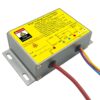 |
ACCHV12V6KV1MAW | 0 to 6kV | 1mA | 12V ± 1V | Lead Wire | $169.00 | Made to Order | ||
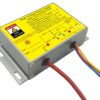 |
ACCHV24V6KV1MAW | 0 to 6kV | 1mA | 24V ± 1V | Lead Wire | $169.00 | Made to Order | ||
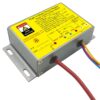 |
ACCHV12V3KV10MAW | 0 to 3kV | 10mA | 12V ± 1V | Lead Wire | $299.00 | Made to Order | ||
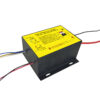 |
ACCHV24V8KV3R5MAW | 0 to 8kV | 3.5mA | 24V ± 1V | Lead Wire | $399.00 | 2 | ||
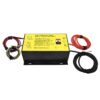 |
ACCHV24V23KV1R4MAW | 0 to 23kV | 1.4mA | 24V ± 1V | Lead Wire | $419.00 | Made to Order | ||
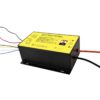 |
ACCHV12V10KV2MAIW | 0 to 10kV | 2mA | 12V ± 1V | Lead Wire | $499.00 | 2 | ||
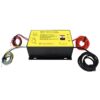 |
ACCHV12V3KV10MAIW | 0 to 3kV | 10mA | 12V ± 1V | Lead Wire | $539.00 | 9 |
Our Delivery Promise
Fast, flexible fulfillment from San Jose, California, USA — shipped worldwide.
- Fast in-stock shipping — In-stock orders ship within 1–2 business days after confirmation and quality check.
- Made-to-order models — Some models are produced to order. Contact sales@analogti.com for the current lead time.
- Worldwide shipping — Shipped from San Jose to customers worldwide.
- Flexible carrier options — UPS, FedEx, DHL, USPS, freight forwarders, or your preferred logistics partners.
- Clear shipment visibility — Tracking provided after dispatch to support your receiving and production planning.
Charging at constant current
The current does not fall off as the bank voltage rises. That single property is the reason this series exists, and it changes how the charge behaves from beginning to end.
Charging a capacitor through an ordinary voltage source is an RC curve — a large inrush at the start, then a long slow approach to the target. The supply spends the first moment in current limit or fault, and the last stretch crawling. With constant current the bank climbs on a straight ramp instead, with no exponential tail to wait out, and the cycle repeats the same way every time.
How long that ramp takes depends on your bank capacitance, your target voltage and the model’s charging current. Take the figure from the datasheet for the model you are considering rather than from an idealised calculation, or send us your numbers and we will confirm it.
- Set the target voltage on the control pin. 0–5 V maps to zero through the model’s full rating, the same interface as the DC-DC modules. The supply charges at constant current until it reaches that voltage, then holds.
- Use the shutdown pin between shots. Pull SDN below 0.8 V to stop the charge electronically, above 1.2 V or floating to run. This is how you gate charging from a controller without switching the input rail.
- Budget the input current. A 3 kV 10 mA model draws around 900 mA at 12 V idling and up to 3.7 A charging. The low-voltage supply needs to be sized for that, not for the output power.
- Decide whether you need an isolated model. Two of the seven carry an I in the code: ACCHV12V3KV10MAIW is rated at 5 kV input-to-output, and ACCHV12V10KV2MAIW at 13 kV. The other five are not specified for isolation. An isolated model costs more than the equivalent rating without it — but if the discharge side of your circuit sits at a different potential from your low-voltage electronics, it is not optional.
Tell us your bank capacitance, target voltage and how often you need to fire, and we will tell you which model keeps up. Contact engineering.
Questions about this series
What happens when the bank reaches the set voltage?
The supply stops charging at constant current and holds the bank at the voltage you set on the control pin. It behaves like an ordinary supply from that point on, until you discharge and it starts charging again.
How fast can I repeat the charge and discharge cycle?
The charging time sets the floor — you cannot fire faster than the bank refills. Work from the charging data in the datasheet for the model you are considering, then leave margin. If your repetition rate needs more current than 10 mA, tell us; the standard series tops out there.
Can I use a regular DC-DC high voltage supply instead?
For a single slow charge, sometimes. For repeated charging, it is the wrong tool: an empty capacitor looks like a short, so the supply hits its protection every cycle. That is hard on the supply and gives you no control over how long charging takes.
Is the output isolated?
On two of the seven models. The rating is specified per part rather than across the series: ACCHV12V3KV10MAIW is rated at 5 kV input to output, ACCHV12V10KV2MAIW at 13 kV. The other five carry no isolation specification, so do not assume a barrier is there.
Can you build a higher-current or higher-voltage version?
Yes, for OEM quantities. Send us the bank capacitance, target voltage, repetition rate and the input rail you have, and we will tell you what is feasible.