
Isolation Amplifiers
An isolation amplifier passes an analog signal across a galvanic barrier. The input side and the output side share no electrical connection, so a shunt sitting at 1,000 V, a sensor on a motor drive or a floating thermocouple can be measured by grounded equipment without the two sides ever meeting. Use one when ground loops, common-mode voltage or fault protection stand between your sensor and your ADC.
ATI builds upgraded drop-in replacements for the AD202, AD210 and AD215. The original manufacturer discontinued all three families and named no replacement part for any of them. Ours keep the pinout and the footprint, run substantially faster — the AD202ATI at 800 kHz where the original managed 2 kHz — and are RoHS compliant, which the originals were not. Nine models from $75, in DIP and SIP, with isolated power built in and a 10-year production guarantee in the datasheet.
All nine models
The whole range fits in one table, grouped by family. If you are replacing an existing part, find the original number and add ATI to it — AD202KN becomes AD202KNATI, AD215BY becomes AD215BYATI, and the pinout does not change. If you are designing something new, the family guide below narrows nine parts to one in a single table: isolation and package first, then accuracy.
Showing all 9 resultsSorted by price: low to high
| Image | SKU | Isolation Rating | Bandwidth | Linearity | Power Supply Current | Package Type | Datasheet | Price | Stock | Action |
|---|---|---|---|---|---|---|---|---|---|---|
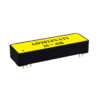 |
AD202JNATI | 750V rms | 800kHz | ± 0.02% | 12mA | DIP | $75.00 | 110 | ||
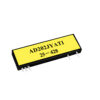 |
AD202JYATI | 750V rms | 800kHz | ± 0.02% | 12mA | SIP | $75.00 | 21 | ||
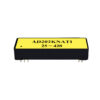 |
AD202KNATI | 1500V rms | 800kHz | ± 0.02% | 12mA | DIP | $79.00 | 133 | ||
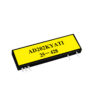 |
AD202KYATI | 1500V rms | 800kHz | ± 0.02% | 12mA | SIP | $79.00 | 88 | ||
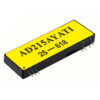 |
AD215AYATI | 750V rms | 300kHz | ± 0.02% | +30/−30mA | SIP | $109.00 | Made to Order | ||
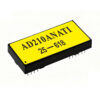 |
AD210ANATI | 2500V rms | 500kHz | ± 0.025% | 30mA | DIP | $119.00 | 1 | ||
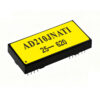 |
AD210JNATI | 1500V rms | 500kHz | ± 0.025% | 30mA | DIP | $119.00 | Made to Order | ||
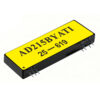 |
AD215BYATI | 1500V rms | 300kHz | ± 0.02% | +30/−30mA | SIP | $119.00 | Made to Order | ||
 |
AD210BNATI | 2500V rms | 500kHz | ± 0.025% | 30mA | DIP | $129.00 | Made to Order |
Our Delivery Promise
Fast, flexible fulfillment from San Jose, California, USA — shipped worldwide.
- Fast in-stock shipping — In-stock orders ship within 1–2 business days after confirmation and quality check.
- Made-to-order models — Some models are produced to order. Contact sales@analogti.com for the current lead time.
- Worldwide shipping — Shipped from San Jose to customers worldwide.
- Flexible carrier options — UPS, FedEx, DHL, USPS, freight forwarders, or your preferred logistics partners.
- Clear shipment visibility — Tracking provided after dispatch to support your receiving and production planning.
Which family do I need?
Three families, and they do not overlap much. Isolation voltage and bandwidth pull in opposite directions, so start with whichever of the two your application fixes.
| Family | Isolation | Bandwidth | Nonlinearity | Package | Choose this if… |
|---|---|---|---|---|---|
| AD202ATI 4 models · $75–$79 | 750 V or 1500 V rms | 800 kHz | ±0.02 % | DIP or SIP | The fast one, and the cheapest. 0.5 µs rise time and 12 mA supply current. Take this unless you specifically need more isolation or tighter linearity. |
| AD210ATI 3 models · $119–$129 | 1500 V or 2500 V rms | 500 kHz | ±0.025 % | DIP | You need the highest isolation here, or three-port isolation — input, output and power all separated, with ±15 V isolated power available at both ends. Use it as an input or an output isolator without redesign. |
| AD215ATI 2 models · $109–$119 | 750 V or 1500 V rms | 300 kHz | ±0.005 % or ±0.01 % | SIP | The accurate one. ±0.005 % on the BY grade, −80 dB distortion, and a built-in supply giving ±15 V at ±10 mA — enough to run a front-end amplifier or transducer excitation, not just the module itself. |
Reading the part numbers, and reading the isolation ratings
- Add ATI to the original number. AD202KN becomes AD202KNATI, AD210BN becomes AD210BNATI, AD215AY becomes AD215AYATI. The letters keep their original meanings: in the AD202 family J and K are the isolation grades (1000 V and 2000 V peak) while N and Y are the packages (DIP and SIP). In the AD210 family J, A and B run from lowest to highest specification.
- Isolation is quoted in volts rms throughout, so the three families compare directly. Every datasheet also gives a paired continuous peak rating for the same barrier: 750 V rms is ±1000 V peak, 1500 V rms is ±2000 V peak, and 2500 V rms is ±3500 V peak. Both numbers describe one barrier, not two ratings — the rms figure is the one tested on every unit.
- Linearity is set by family, not by grade — with one exception. Every AD202ATI is ±0.02 % and every AD210ATI is ±0.025 % regardless of grade; in those families the letter buys isolation voltage, not accuracy. Only the AD215 family separates on both: the BY grade is ±0.005 % typical where the AY grade is ±0.01 %. If your measurement chain is built around a 16-bit converter, start with the AD215ATI rather than assuming the higher-priced family is the more accurate one.
- Isolated power is included in all three families, which is why there is no external DC/DC converter in the bill of materials. How much you can draw and from where varies: the AD215ATI offers ±15 V at ±10 mA at its input port, while the three-port AD210ATI offers ±15 V at ±5 mA at both the input and the output sections, letting you power floating circuitry at either end.
Replacing a part not listed here, or unsure which grade your board was built around? Send us the part number on the module and we will tell you what matches it.
Three things to settle before you order
Most of the difficulty in specifying an isolation amplifier is deciding which of its numbers actually constrains your design.
1. Isolation rating is a survival spec, not an accuracy spec
The isolation voltage tells you what the barrier withstands without breaking down. It says nothing about how cleanly your signal crosses it — that is common-mode rejection, quoted separately at 105 dB to 130 dB depending on the family. The two get confused constantly. Size the isolation rating from the worst-case voltage the input side can reach, including fault conditions rather than normal operation, and then check CMR against the noise you need to reject. A part with enormous isolation and mediocre CMR will survive your fault and still give you a poor measurement.
2. Bandwidth, and what you are really asking for
These families span 300 kHz to 800 kHz of full-power bandwidth, which is a great deal more than most isolation amplifiers offer and far more than most applications need. If you are measuring a thermocouple, any of them is overkill and you should choose on isolation and linearity instead. Bandwidth matters when you are capturing transients, monitoring power line events or recording waveforms — and in those cases look at rise time and settling time alongside the −3 dB figure, because a fast amplifier that rings is not fast in any useful sense.
3. What you will hang on the isolated supply
Every family here includes isolated power, which is the reason these modules replace a whole subcircuit rather than a single component. The question is how much you intend to draw. If the isolated side is just the module's own input stage, any of them works. If you plan to run a front-end amplifier, a bridge or transducer excitation from it, check the current available before you commit — the AD215ATI is specified at ±10 mA for exactly this purpose, and designing around a rail that cannot supply what you need is a problem discovered late.
Why buy these from ATI
- The originals are gone, and nothing replaced them — Analog Devices discontinued the AD202, AD210 and AD215 families as part of a wider retirement of its modular product line, announced in October 2022, with last shipments in October 2024. Its notice named no replacement part and no pin-compatible alternative for any of them. Our datasheets guarantee production for at least ten years. If you maintain equipment with a service life measured in decades, that is the reason to talk to us.
- Drop-in, and far faster — Same pinout, same footprint, no board changes. The AD202ATI delivers 800 kHz where the original AD202KN managed 2 kHz, with a 0.5 µs rise time against 180 µs. The AD210ATI runs 500 kHz against the original's 20 kHz, at 30 mA against 50 mA. The AD215ATI runs 300 kHz against 120 kHz. Speed and supply current are where the gains are — on linearity the replacements match their originals rather than beating them, and the datasheets say so.
- Isolation ratings are 100 % tested — On the AD210 and AD215 families every unit is tested to its rated isolation voltage rather than qualified by sample.
- Published prices, from $75 — No quote request. For a part you are designing into a long-lived product, knowing the price today and the availability for the next decade is worth more than a discount you have to ask for.
- Since 1997 — Designed and stocked in San Jose, California.
Where these are used
Current shunt measurement
Reading the voltage across a shunt that sits at a high potential, in motor drives, inverters and power converters, without referencing your ADC to that potential.
High-speed data acquisition
Multichannel front ends where each channel floats at a different potential and the converter behind them does not. The AD210's three-port structure suits this particularly well.
Power line and transient monitoring
Capturing events on distribution equipment, where the measurement point carries mains or higher and the recorder must stay isolated from it.
Waveform recording instrumentation
Test and measurement equipment that has to reproduce the shape of a signal faithfully across a barrier — the case where the 300–800 kHz bandwidth is being used rather than merely present.
Vibration and sensor analysis
Accelerometers and strain gauges on machinery, where the sensor needs isolated excitation and the signal has to reach a grounded analyser intact.
Legacy equipment support
Keeping installed systems running now that the original parts have stopped shipping. This is the reason a large share of these ship, and no board redesign is required — the pinout and footprint are unchanged.
Frequently asked questions
Are these genuinely drop-in, or does my board need changes?
Drop-in. Pinout and package match the original part, so an AD202KNATI goes into a board laid out for an AD202KN with no changes to the layout or the supporting components. What changes is performance: the replacement is faster and, in most grades, more linear. If your circuit was designed around the original part's bandwidth limit — using it as a filter, for instance — that is worth a look before you swap, because the new part will pass signals the old one attenuated.
What does three-port isolation mean, and do I need it?
In a three-port design the input, the output and the power supply are all isolated from one another, rather than the power sharing a common with one side. The practical consequence is flexibility: the module can be used as an input isolator or an output isolator without redesign, and in a multichannel system each channel can sit at a different potential while sharing one supply. The AD210ATI is the three-port family here. If you have one signal going one direction and a single ground reference, you do not need it.
How do I compare a rating in volts rms with one in peak volts?
Multiply the rms figure by about 1.4 to get the equivalent peak, or divide a peak figure by 1.4 to approximate rms. We quote rms on this page because that is the value tested on every unit, and each datasheet gives the paired peak rating alongside it: 750 V rms with ±1000 V peak, 1500 V rms with ±2000 V peak, 2500 V rms with ±3500 V peak. Check which convention a competing datasheet uses before you compare — a part quoted at 2500 V rms is not weaker than one quoted at ±3000 V peak, it is stronger.
Do I need an external isolated DC/DC converter?
No. Every family here generates its isolated supplies internally from a single input supply, which is the main reason these modules replace a subcircuit rather than a component. Some of them go further and make that isolated rail available to you: the AD215ATI provides ±15 V at ±10 mA at its input port for a front-end amplifier, signal conditioning or transducer excitation.
My AD202KNATI behaves differently from one I bought years ago. Why?
There is a design change in the AD202ATI's history marked by serial number. In the DIP parts, units numbered up to 25156 have an output that is not isolated from the power supply and a 20 kHz bandwidth; above that number the output is isolated and the bandwidth is 800 kHz. For the SIP parts the boundary is 25290. The earlier version is out of production. If you are comparing two units or matching a board built around an early part, check the serial number before assuming a fault, and tell us if you need help identifying what you have. The same applies to our older ATIA202KN and ATIA202KY, which are discontinued and replaced identically by the AD202KNATI and AD202KYATI.
Isolation voltage and common-mode rejection — what is the difference?
Isolation voltage is what the barrier survives; common-mode rejection is how well the amplifier ignores voltage that appears on both inputs at once. A part can have a very high isolation rating and still let common-mode noise contaminate your measurement, or excellent rejection and an inadequate barrier for your fault case. You need both specified for your application: the barrier sized for the worst voltage the input side can reach, and the rejection sized against the interference you are trying to keep out of the reading.
Why were the original parts discontinued, and what are my options now?
Analog Devices retired its modular product line, and the AD202, AD210 and AD215 went with it — announced in October 2022, last orders in 2023, last shipments in October 2024. These were never ordinary chips: each is a potted module with transformers and discrete components inside, assembled rather than fabricated, which is why an aging line of them was retired together rather than individually. The discontinuance notice named no replacement and no pin-compatible alternative, and the manufacturer's modern digital isolators are a different kind of device that would mean redesigning your board. That leaves three options: buy remaining stock from brokers at broker prices and hope it lasts, redesign the circuit, or fit a drop-in replacement. We build the third one.
Are these RoHS compliant?
Yes, and this is one place where the replacement is not merely equivalent to the original. The parts these supersede were sold as non-RoHS, so anyone shipping into a market with compliance requirements had a problem with them independently of the obsolescence. Ask us and we will send the documentation.
How long will these stay available?
Our datasheets carry a stated guarantee of production for at least ten years. We build these because the original manufacturer stopped, and the customers who buy them are typically maintaining equipment with a long service life, so continuity is the point of the product rather than a nice extra. If you are planning a build or a lifetime buy, tell us the quantity and the horizon and we will confirm against the schedule.
Which family and grade should I choose?
If you are replacing an existing part, the answer is already decided — add ATI to the number on the module. For a new design, take it in this order. Isolation first: pick a rating that exceeds the worst-case voltage across the barrier including faults, not just normal operation. Then accuracy: if you need better than ±0.02 %, the AD215ATI is the only family here that offers it, and within it the BY grade reaches ±0.005 %. Then bandwidth, which is generous across all three and rarely the constraint. Within the AD202 and AD210 families the grade letter buys isolation voltage rather than accuracy, so paying up for a higher grade you do not need gains you nothing.