
NTC Thermistors
An NTC thermistor is a small, inexpensive temperature sensor whose resistance drops as it gets hotter. Use one when you need to hold or read a temperature to a fraction of a degree — a laser diode, a TEC cold plate, a battery pack, a medical instrument. If you need to measure past +300 °C, or want a straight-line output with no maths, an RTD or thermocouple suits you better.
ATI makes these as glass-encapsulated beads from Ø0.55 mm, plus ready-to-mount ring-lug, hex-nut and sealed stainless assemblies. 5 kΩ to 230 kΩ, ±0.5% or ±1%, from $1.60. Glass bodies barely drift over years and take far more heat than the usual epoxy parts. All of them match the R/T curves our TEC controllers expect.
Find your NTC thermistor
Filter by resistance, package type and lead type. Every row shows B-value, bead diameter, temperature range, response time, price and datasheet. Not sure where to start? The form-factor guide below narrows it to one group, and 10 kΩ with a 3950 K curve is the right answer for most people.
Showing 13–24 of 74 resultsSorted by price: low to high
| Image | SKU | R₂₅ | Tol. | B-Value | Bead Ø | Time Const. | Package Type | Lead Type | Datasheet | Price | Stock | Action |
|---|---|---|---|---|---|---|---|---|---|---|---|---|
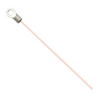 |
ATH10KL2D | 10K | 1% | 3950K @ 25/50°C | - | 37.8s | Ring Lug | Bare leads | $1.80 | Made to Order | ||
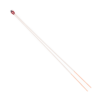 |
ATH100K1R25T70 | 100K | 1% | 3950K @ 25/50°C | 1.25mm | 2.39s | Bare Bead | Tubing-NonSealed | $2.00 | 102 | ||
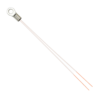 |
ATH100KL2BT70 | 100K | 1% | 3950K @ 25/50°C | - | 37.8s | Ring Lug | Tubing-NonSealed | $2.00 | 9 | ||
|
ATH100KL2CT70 | 100K | 1% | 3950K @ 25/50°C | - | 37.8s | Ring Lug | Tubing-NonSealed | $2.00 | 100 | ||
|
ATH10K1R25T70 | 10K | 1% | 3950K @ 25/50°C | 1.25mm | 2.39s | Bare Bead | Tubing-NonSealed | $2.00 | 85 | ||
|
ATH10KL2BT70 | 10K | 1% | 3950K @ 25/50°C | - | 37.8s | Ring Lug | Tubing-NonSealed | $2.00 | 35 | ||
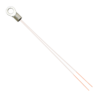 |
ATH10KL2CT70 | 10K | 1% | 3950K @ 25/50°C | - | 37.8s | Ring Lug | Tubing-NonSealed | $2.00 | 45 | ||
|
ATH10KL2DT70 | 10K | 1% | 3950K @ 25/50°C | - | 37.8s | Ring Lug | Tubing-NonSealed | $2.00 | Made to Order | ||
 |
ATH10KR8B3404K | 10K | 1% | 3404K @ 25/50°C | 0.8mm | 4s | Bare Bead | Bare leads | $2.00 | 399 | ||
|
ATH100K1R25T70S | 100K | 1% | 3950K @ 25/50°C | 1.25mm | 2.39s | Bare Bead | Tubing-Sealed | $2.20 | 100 | ||
|
ATH100KL2BT70S | 100K | 1% | 3950K @ 25/50°C | - | 37.8s | Ring Lug | Tubing-Sealed | $2.20 | 16 | ||
|
ATH100KL2CT70S | 100K | 1% | 3950K @ 25/50°C | - | 37.8s | Ring Lug | Tubing-Sealed | $2.20 | 38 |
Our Delivery Promise
Fast, flexible fulfillment from San Jose, California, USA — shipped worldwide.
- Fast in-stock shipping — In-stock orders ship within 1–2 business days after confirmation and quality check.
- Made-to-order models — Some models are produced to order. Contact sales@analogti.com for the current lead time.
- Worldwide shipping — Shipped from San Jose to customers worldwide.
- Flexible carrier options — UPS, FedEx, DHL, USPS, freight forwarders, or your preferred logistics partners.
- Clear shipment visibility — Tracking provided after dispatch to support your receiving and production planning.
Which form factor do I need?
Five ways to get the bead onto the thing you are measuring. Pick the mounting first, then use the filter above for resistance and B-value.
| Form factor | Size | Resistance | B-value | Response | Choose this if… |
|---|---|---|---|---|---|
| Bare bead 38 models · $1.80–$9.90 | Ø0.55–1.3 mm leads same end |
5K · 10K · 20K 30K · 50K · 100K · 230K |
3404K – 4177K | 1–14 s in air under 1 s in liquid |
This is the one most people need. The bead sits directly against what you are measuring — a laser diode chip, a TO-can, a small metal surface. Widest choice of resistance and tolerance. The Ø0.55 mm bead fits inside a butterfly package. |
| Axial leaded 6 models · $1.60 | Ø1.8 mm leads opposite ends |
5K · 10K · 20K 30K · 50K · 100K |
3950K | 20 s in air | You are putting it on a board, or buying in volume. Cheapest part in the range, one price for every resistance value. Leads exit both ends, so it drops into a through-hole footprint. Good for battery packs and consumer products. Slowest of the bead types. |
| Ring lug 24 models · $1.80–$3.90 | hole Ø2.18–5.3 mm M2 to M5 screw |
10K · 100K | 3404K · 3478K 3950K · 4066K |
about 1 s in water 2–38 s in still air |
You are bolting it to metal. Heat sink, cold plate, laser submount, motor housing, busbar. One screw and it is done — no adhesive, no thermal paste step, no hole to drill. Four lug sizes so it matches the screw you already use. |
| Hex nut 4 models · $3.50 | M3 or M4 stud 6 mm long · body 4–12 mm |
10K | 3950K | 38 s in air 1.2 s in water |
You want to screw it into something. Metal blocks, fluid manifolds, housings, transformer and motor windings. Standard M3 and M4 threads, so the mating hardware is whatever you already stock. The thread gives you a repeatable mounting depth and a defined torque, which matters when the same part gets fitted a hundred times on a line. Copper-coated leads solder straight on. |
| Sealed stainless assembly · $3.00 | 18-8 stainless flange + 800 mm lead |
230K | 4170K | ≤±1 °C at 95–102 °C |
It is going into liquid, or somewhere wet. Boilers, heat pumps, dishwashers, wash-down equipment. Sealed stainless cap survives moisture and acid; the flange bolts to a chassis. Ships with a 2-pin plug already fitted. Minimum order 5 pcs. |
How to read the part number:
- No suffix: bare tinned leads. Solder them or crimp them yourself.
- T63 / T65 / T70: leads covered with PFA insulating tubing, not sealed. The number is the lead length in mm. Adds $0.20 and stops the two leads shorting against each other or the chassis.
- T63S / T65S / T70S: same tubing, plus the joint at the bead is sealed against moisture. Another $0.20. Use it for humid, condensing, medical or sterilised environments.
- Same bead, same curve: a base part and its T / TS versions are electrically identical and share one datasheet. You are only choosing how the leads are finished.
- Hex nut numbering: the number in ATH10KHN4 / HN6 / HN10 / HN12 is the length of the hex body in mm, not the thread size. All four have a 6 mm threaded stud: M3 on HN4 and HN10, M4 on HN6 and HN12. Pick the thread first, then the body length that suits your fixture.
- Custom: lead length, connector, housing and resistance value can be built to order for OEM quantities. Tell us what you need.
Which resistance and B-value?
If you are unsure, buy 10 kΩ with a 3950 K curve. That is what most TEC controllers, laser modules and instrument inputs expect, and it is the most stocked value we hold.
The rule that catches people out: match the curve your controller was designed for, not the highest B-value on the page. A controller converts resistance to temperature using one fixed R/T table. Fit a 3404 K part where the controller expects 3950 K and every reading is off by a few degrees — the loop still looks stable, so the error is easy to miss for weeks.
Higher resistance (50 kΩ, 100 kΩ, 230 kΩ) means less current for the same signal, so less self-heating and less trouble over a long cable. Lower resistance suits low-impedance inputs. Tolerance is the other lever: at 25 °C a ±1% part lands within roughly ±0.2 °C without calibration, a ±0.5% part within roughly ±0.1 °C. That step costs about $0.30. Further from 25 °C the tolerance on the B-value adds to it, so if you need a tight number at 60 °C or −20 °C, plan to calibrate at your working temperature rather than trusting the room-temperature figure.
Tell us your controller model, target temperature and what the sensor mounts to, and we will name the part. Contact engineering, or filter by resistance if you already know the value you need.
Why buy from ATI
Six reasons customers pick these over a generic catalogue thermistor.
- Every part here is glass-encapsulated. Not one epoxy part in the range — including the beads inside the ring-lug, hex-nut and stainless assemblies. Glass barely drifts over years of operation and takes far more heat. Epoxy parts drift slowly, and a slow drift is the failure nobody notices, because the controller keeps reporting a temperature that looks fine. For most customers this is the deciding factor.
- Bolt-on and screw-in versions are stock parts. Ring-lug and hex-nut assemblies are catalogue items, not a custom build. That removes the fixture, the adhesive and the drilling step from your assembly instructions, and it removes the guesswork about whether the bead is really touching the metal.
- Down to Ø0.55 mm. Small enough to go inside a butterfly laser package or against a TO-can, where a larger bead simply will not fit. Small beads also settle fastest — about one second in air.
- Prices are published. From $1.60, listed on every product page, with volume pricing on request. No quote needed to find out whether it fits your budget.
- Sealed variants are on the shelf. Every base part is available with PFA tubing, and with the bead sealed against moisture. You do not have to potting-compound your way around a humidity problem.
- Curve-matched to our thermal products. These are the same parts our TEC controllers and TEC modules are specified with, so the sensor, the cooler and the loop are known to work together. Pb-free throughout; RoHS and REACH certificates available on request.
- RoHS and REACH compliant — Every thermistor is 100 % lead-free, and the certificates are on file: RoHS certificate and REACH certificate of compliance.
What people use these for
Anything that has to be held at a temperature, or watched in case it leaves one.
- Laser diodes and optical modules — the most common use. A small bare bead against the chip or submount, closing the loop on a TEC controller.
- TEC cold plates and thermal assemblies — the feedback sensor in a Peltier temperature loop.
- Imaging sensors — CCD and infrared detectors held at a fixed temperature to keep noise down.
- Medical and analytical instruments — incubators, reagent blocks, sterilisable probes. Long-term stability matters more than initial accuracy here.
- Battery packs and BMS — cell and hotspot monitoring, usually axial or ring lug, over a wide ambient range.
- Motors, transformers and power electronics — winding and heat-sink temperature, bolted or screwed straight onto metal.
- Industrial fluid and HVAC — oil, water and air temperature, ducts and manifolds. Use the hex-nut or sealed stainless versions.
- Appliances and consumer products — boilers, heat pumps, dishwashers. Cost per unit drives the choice, and the sealed assembly handles the wet end.
Questions we get asked
What is the difference between an NTC and a PTC thermistor?
An NTC drops in resistance as it warms up. A PTC rises. NTCs are the sensing devices — they are more sensitive, so they are what you use to measure and control temperature. PTCs are mostly used as protection parts. Everything on this page is NTC.
What does the B-value mean?
It describes how steeply the resistance changes with temperature, in kelvin. A higher B-value gives a bigger resistance change per degree, over a narrower useful span. Ours run from 3404 K to 4177 K.
The number that matters is not “higher is better” but “does it match my controller”. Pick the B-value your instrument expects.
10 kΩ, 100 kΩ or 5 kΩ — which should I buy?
10 kΩ at 25 °C is the default and the safe answer. It is the standard for TEC controllers, laser diode modules and general instrumentation.
Go higher (50 kΩ to 230 kΩ) when you want minimal self-heating, or when the sensor sits at the end of a long cable. Go lower (5 kΩ) only if your input circuit was designed for it.
Glass or epoxy encapsulation?
Glass — and every thermistor on this page is glass, including the beads sealed inside the ring-lug, hex-nut and stainless assemblies. We do not stock an epoxy part.
Glass gives near-zero long-term drift, a wider temperature range and a smaller bead for the same rating. Epoxy is cheaper and fine where a slow drift of a degree over a few years does not matter. If you are running a control loop, or the instrument has to stay calibrated, that drift is exactly what you are paying to avoid.
Do I need the tubing or sealed version?
Bare leads are fine on a dry board where you control the routing. Add T-series PFA tubing if the leads could touch each other or the chassis. Add the S (sealed) version if there is any chance of moisture, condensation, cleaning fluid or steam sterilisation reaching the bead. The electrical specs do not change.
How much current can I put through it?
Less than you might think. Current heats the bead, and a bead that heats itself reports its own temperature instead of yours. Each datasheet gives a dissipation factor — the power that raises the bead by 1 °C — and a maximum power rating, typically 18 to 50 mW.
In a normal 10 kΩ divider the current is tiny and self-heating is negligible. Problems start when the divider resistor is far too small, or the part is driven from a rail directly.
Can I use one of these to limit inrush current?
No. Sensing NTCs and inrush-limiting NTCs are opposite tools. A sensing NTC is meant to stay cool and report the truth; an inrush limiter is meant to heat itself deliberately. Put a sensing part in a power input and it will overheat and fail, sometimes short, sometimes open.
My readings have drifted. What happened?
Drift is the failure to watch for, because open and short circuits are obvious and drift is not — the controller keeps trusting a wrong number. The usual causes are rework heat, moisture getting into an unsealed joint, chemical attack, or a cracked bead from mechanical stress.
Prevention is mostly mechanical: choose the right body and sealing, keep soldering within the datasheet limits, never bend the leads at the bead, and strain-relieve the cable so movement is not fed into the glass.
How fast do they respond?
The small bare beads settle in about one second in air, and well under a second in liquid. Larger beads and the axial parts take longer — up to about 20 seconds in still air.
In practice the mounting decides the answer, not the sensor. A fast bead under a thick blob of adhesive, or with an air gap between it and the surface, will read late and low. Mount it close, use a thin conductive bond, and keep the leads out of the thermal path.
Will these work with my TEC controller?
Yes if the curve matches. Our controllers are specified with these parts, so a 10 kΩ / 3950 K part works out of the box. For a third-party controller, check which R25 and B-value its temperature table assumes, then filter for that combination above.
What thread do the hex-nut assemblies use?
Standard metric. ATH10KHN4 and ATH10KHN10 are M3; ATH10KHN6 and ATH10KHN12 are M4. The threaded stud is 6 mm long on all four.
The number in the part name is the length of the hex body, not the thread size — so HN4 and HN10 share the same M3 thread and differ only in how far the body stands off the surface.
Can you build a custom assembly?
Yes. Lead length, wire gauge, connector, housing shape and resistance value are all changeable for OEM quantities. Send us a drawing or a description of the mounting and the environment. Minimum order quantities apply.
Are they RoHS and REACH compliant?
Yes, and lead-free throughout. Certificates of compliance are available on request.