
Precision Sensors & Inertial Systems
These sensors report how something is oriented or how it is moving — the angle of a machine arm, the heading of a vehicle, the rotation rate of a platform. Use one when a control system has to react to attitude rather than to position. If you only need to know where something is, a satellite receiver answers that question at a far lower cost, and only the navigation system at the top of this range does both.
ATI builds 25 sensors in two families: tilt and inclination, and inertial and navigation. Tilt accuracy runs from ±0.2° down to ±0.001°, every tilt sensor is IP67 rated for −40 to +85 °C, and outputs cover CAN, RS485, Modbus RTU, analog voltage and current loop. Prices start at $99.
Two families
Tilt & Inclination Sensors measure a static angle against gravity. They are the right choice for machine arms, platforms, masts and structures that move slowly. Inertial & Navigation Sensors measure rotation, acceleration and heading. They are the right choice when the equipment itself is moving and the angle alone is not enough.
Our Delivery Promise
Fast, flexible fulfillment from San Jose, California, USA — shipped worldwide.
- Fast in-stock shipping — In-stock orders ship within 1–2 business days after confirmation and quality check.
- Made-to-order models — Some models are produced to order. Contact sales@analogti.com for the current lead time.
- Worldwide shipping — Shipped from San Jose to customers worldwide.
- Flexible carrier options — UPS, FedEx, DHL, USPS, freight forwarders, or your preferred logistics partners.
- Clear shipment visibility — Tracking provided after dispatch to support your receiving and production planning.
What we stock
Six kinds of sensor across the two categories. Find the type you need, then open that category for the exact model.
| Type | What it tells you | Key numbers | Category |
|---|---|---|---|
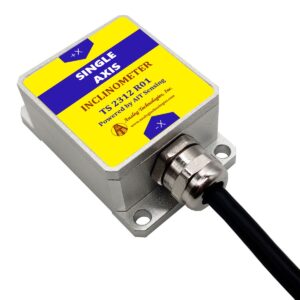
| Tilt Sensors 12 models · $99–$1,599 | The angle of the surface it is bolted to, measured against gravity | ±0.2° to ±0.001° accuracy · ±15°, ±30° or ±90° range single or dual axis · CAN, RS485, Modbus RTU, 0–10 V, 4–20 mA |
Tilt & Inclination |
| Machine Inclinometers 3 models · $569 | Boom, bucket and body angle on construction machinery | ±0.1° over ±90° · RS485 and CAN three pre-configured mounting orientations |
Tilt & Inclination |
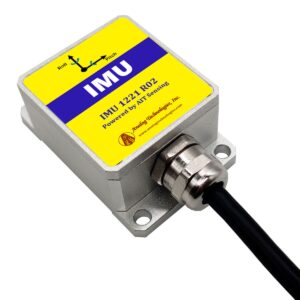
| IMU 2 models · $99 | Angular rate and acceleration, six axes of raw motion data | 6-axis · RS232 or RS485 · 5 VDC 55 × 37 × 24 mm |
Inertial & Navigation |
| Electronic Compass 5 models · $310–$2,599 | Which way the unit is pointing, as a heading | 3-axis · RS232, RS485 or TTL · 5–12 VDC two accuracy grades |
Inertial & Navigation |
| Fiber Optic Gyro 2 models · $6,899–$21,999 | Rotation rate, with no moving part and very low drift | single-axis and 3-axis · RS422 · 5 VDC for stabilization, north-finding and guidance |
Inertial & Navigation |
| Inertial Navigation System 1 model | Position, velocity and attitude combined into one solution | heading 0.05° · position 1.5 m RS232, RS422, CAN and Ethernet · 18–36 VDC |
Inertial & Navigation |
Also worth knowing:
- Accuracy is not resolution: A sensor with 0.001° resolution and ±0.01° accuracy reports very small steps, but the reading can still sit 0.01° away from the true angle. Size your choice by accuracy. Resolution only decides how finely the output is divided.
- Full specifications: Ask us for the complete specification of any inertial or navigation model before you design it in. We will send the full datasheet for the exact part number.
Questions we get asked
Do I need a tilt sensor or an IMU?
A tilt sensor gives you an angle directly, and it stays correct as long as the equipment is not accelerating hard. It is the simpler and cheaper answer for a machine arm, a platform, a mast or a solar tracker.
An IMU gives you rotation rate and acceleration, not an angle. Your software has to turn that raw data into orientation. Choose it when the equipment moves fast enough that a gravity-based reading would be disturbed, or when you need the motion data itself.
Which output interface should I choose?
RS485 and Modbus RTU suit long cable runs and several devices on one bus, which is why most industrial installations use them. CAN suits vehicles and mobile machinery, where a bus already exists.
Analog outputs need no software at all. A 0–10 V output goes straight into a controller input over a short run. A 4–20 mA current loop survives long cables and electrical noise better than a voltage output, and a broken wire is easy to detect because the current falls to zero.
Can these sensors be used outdoors?
Every tilt and inclination model in this section is rated IP67 and specified from −40 to +85 °C, which covers outdoor and mobile machinery use. IP67 means dust-tight and protected against temporary immersion.
The inertial and navigation models are supplied in their own housings, and the rating varies by model. Ask us for the rating of a specific part number before you mount it in an exposed position.